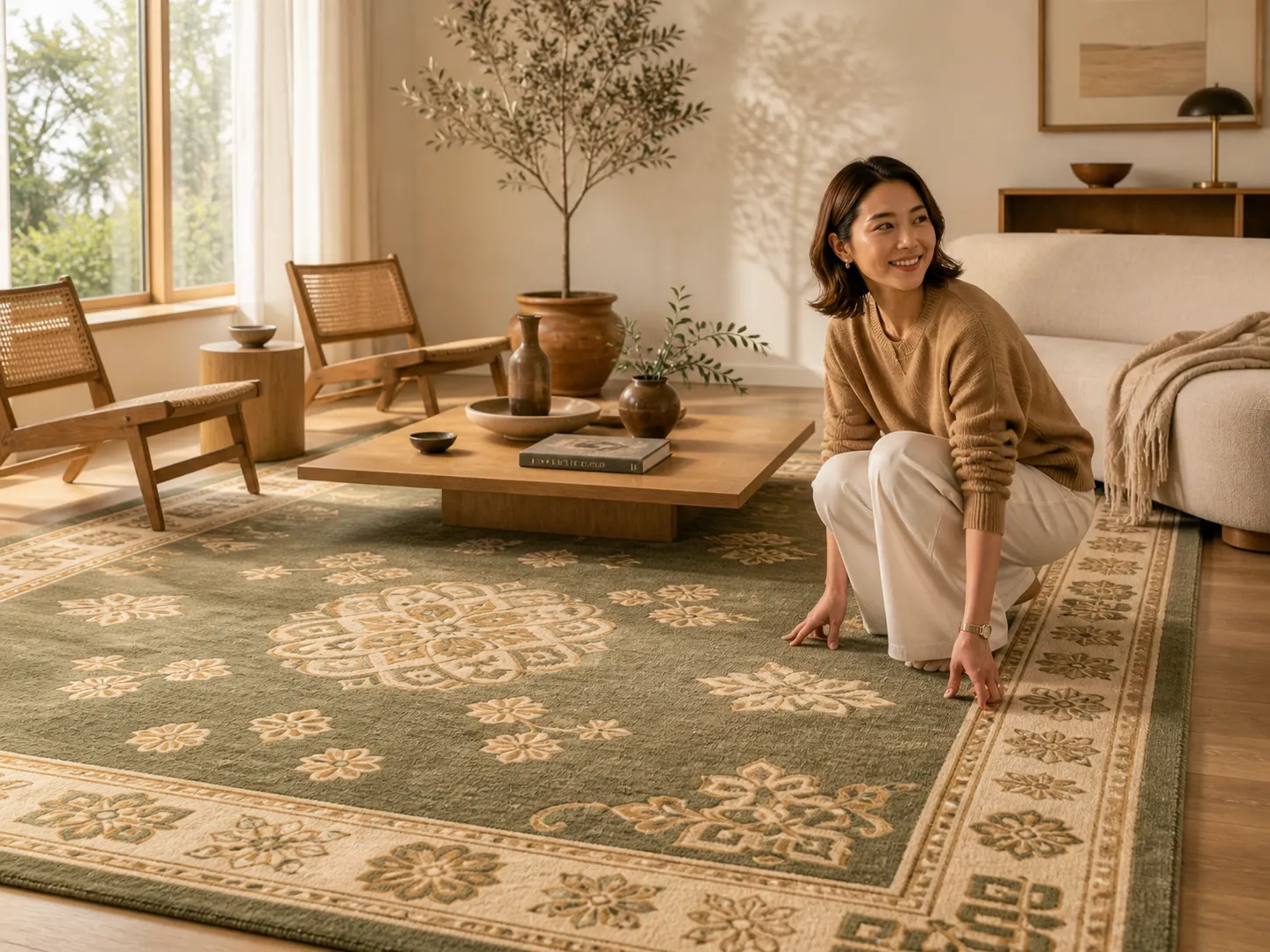
A Chinese Art Deco rug is a hand-knotted wool rug woven in northern China, mostly in Tianjin (then called Tientsin) and Beijing, during the 1920s and 1930s for buyers in America and Europe. It mixes Chinese motifs like lotus, peonies and clouds with Art Deco ideas such as open fields, bold color and off-center layouts, which is why it still looks fresh in a modern room. Prices typically run from under $150 for a machine-made look-alike to roughly $2,000 to $10,000 or more for a room-size antique from a dealer.
So if you have been eyeing one at an estate sale or scrolling dealer listings late at night, you are in good company. Let’s go through it together: where these rugs came from, how to tell a real one from a reproduction, what they actually cost, and how to get the look on a smaller budget.
This post contains affiliate links. As an Amazon Associate, I earn from qualifying purchases, at no extra cost to you.
What Is a Chinese Art Deco Rug?
Think of it as a meeting point between two design worlds. Traditional Chinese rugs, like the classic Peking style, tend to be symmetrical, framed by borders and woven in calm blues and ivory. Chinese Art Deco rugs kept the Chinese symbols but loosened everything else: wide open grounds, motifs drifting into one or two corners, sculpted pile and colors that were daring for the time.
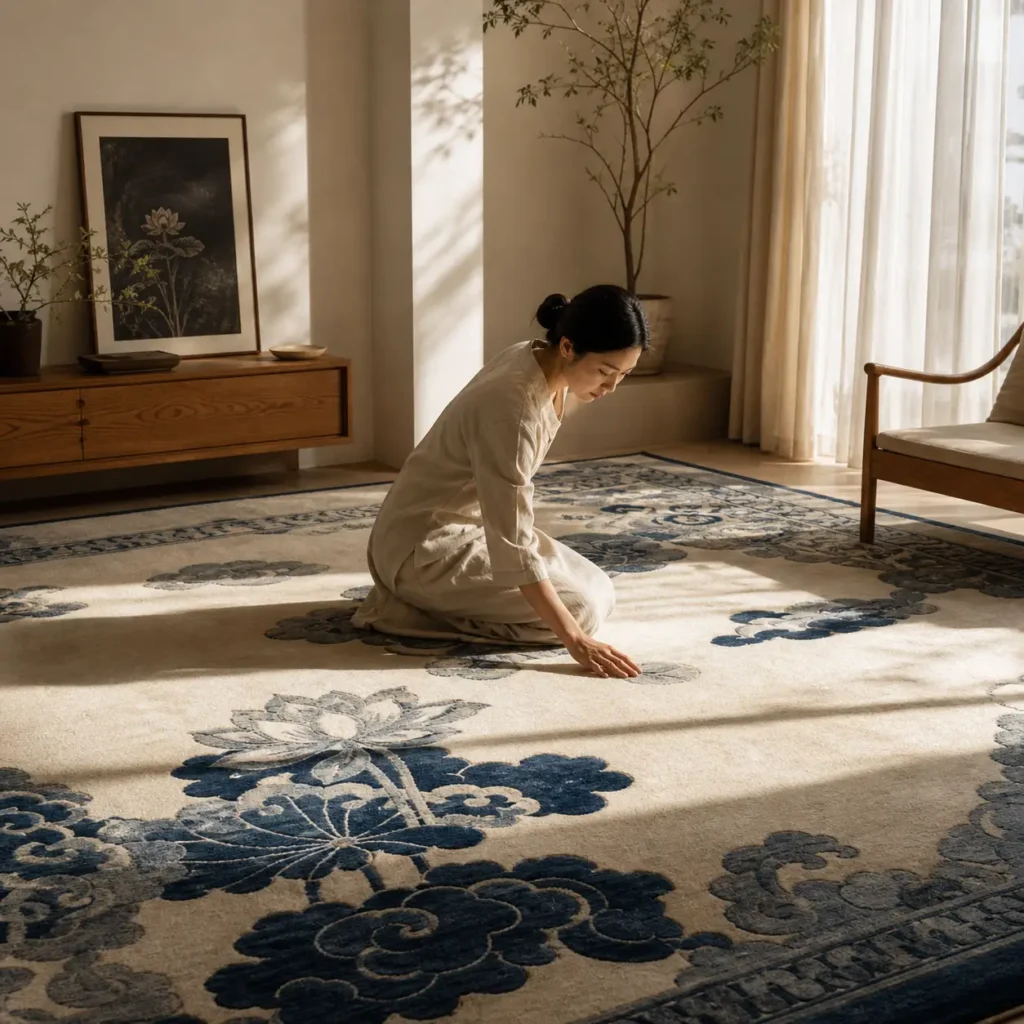
The name borrows from Art Deco, the style launched at the 1925 Paris exhibition of decorative and industrial arts. Collectors also use “Chinese Deco,” “Nichols rug” and “Fette rug” for the same family of pieces.
A Short History of Art Deco Chinese Rugs
Rug weaving in Tianjin and Beijing grew into a large export industry in the 1920s. Tianjin was a port, so getting rugs onto ships bound for the United States was easy, and hundreds of workshops sprang up. Many rugs were sold through American department stores such as Wanamaker’s and B. Altman.
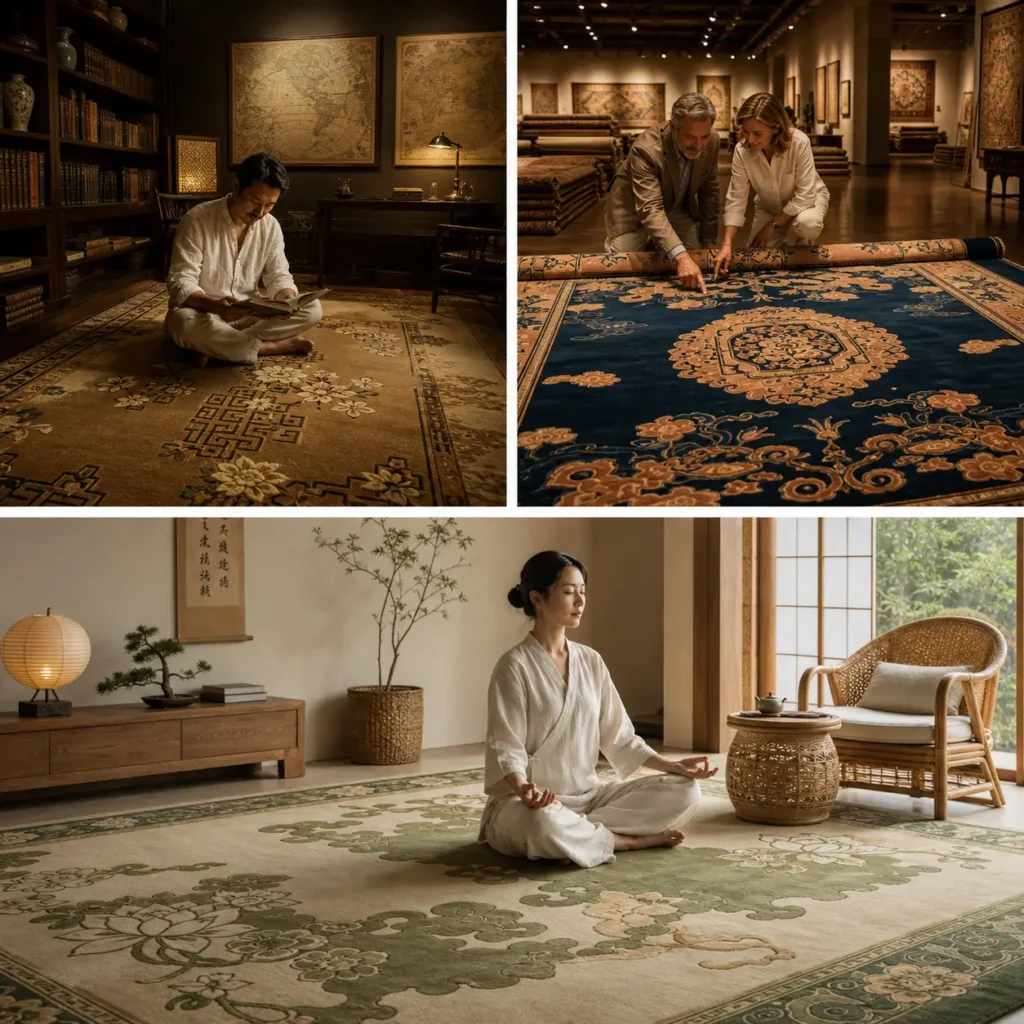
Two American-run companies led the trade. Helen Fette and her partner Li Meng Shu founded the Fette-Li company in Peking in the early 1920s, known for softer, more pliable rugs. The boom faded with the Great Depression, and the war with Japan in the late 1930s ended most production.
Who Was Walter Nichols?
Walter B. Nichols moved from the United States to Tientsin in 1920 and worked as a wool grader before opening his own factory in 1924, Nichols Super Yarn and Carpets. His rugs used machine-spun yarn, strong cotton foundations and imported German chrome dyes, which made them dense, heavy and very colorfast. They sold so widely that “Nichols rug” became shorthand for almost any Chinese Art Deco rug, even ones made by competitors.
Key Design Features of Art Deco Chinese Rugs
Once you know what to look for, these rugs are easy to spot across a room.
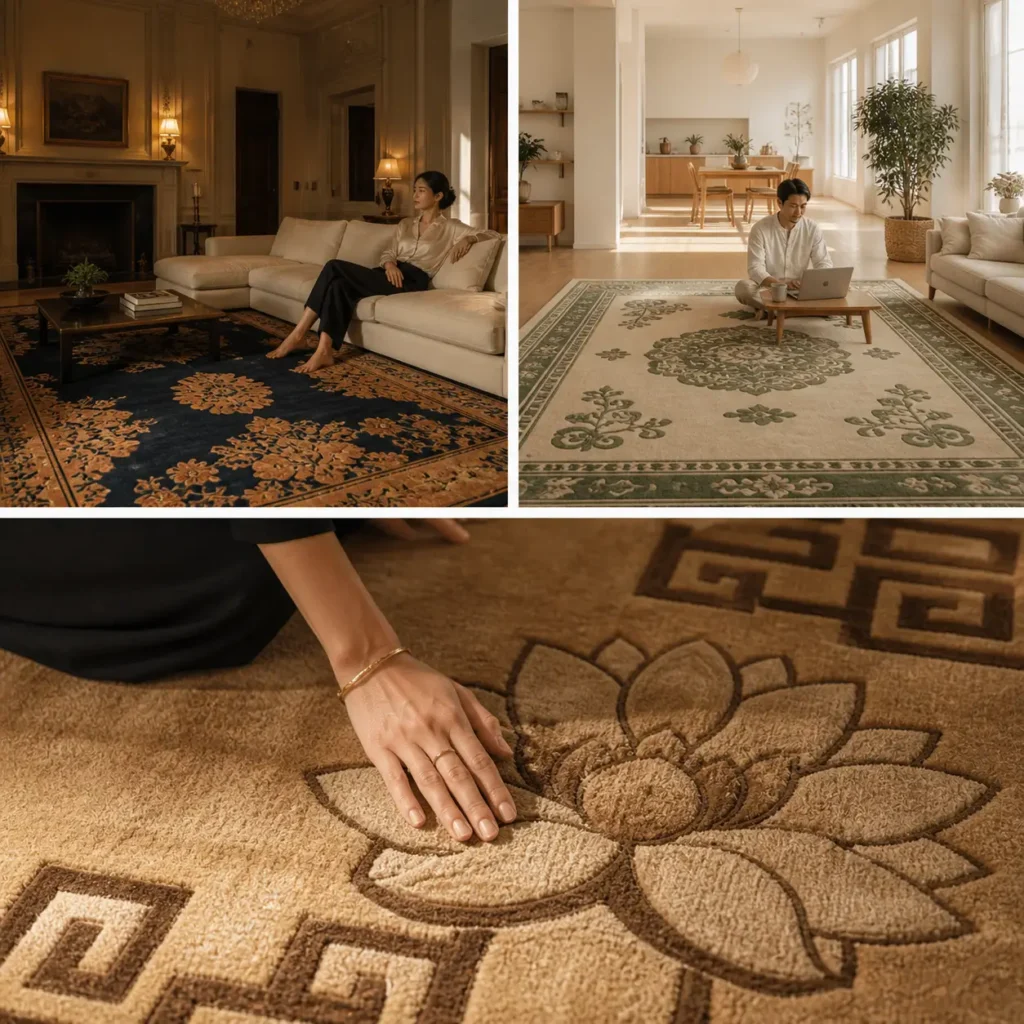
- Open field: large areas of solid color with plenty of breathing room, instead of an all-over pattern.
- Off-center motifs: floral sprays, vases or branches placed in the corners or along one side.
- Bold color: lapis and navy blue, jade green, magenta, plum, teal, apricot and soft camel.
- Carved pile: outlines cut into the wool around motifs so the design stands out in relief.
- Chinese symbols: peonies for wealth, lotus for purity, bats for good fortune and cranes for long life.
Borders are often simple or missing entirely, and when a medallion appears it is usually small and stylized. That restraint is exactly why the style sits so comfortably next to modern furniture.
How to Tell an Authentic Chinese Art Deco Rug From a Reproduction
This is where most buyers get nervous, so here is a simple checklist you can run through with any rug, in person or from good photos.
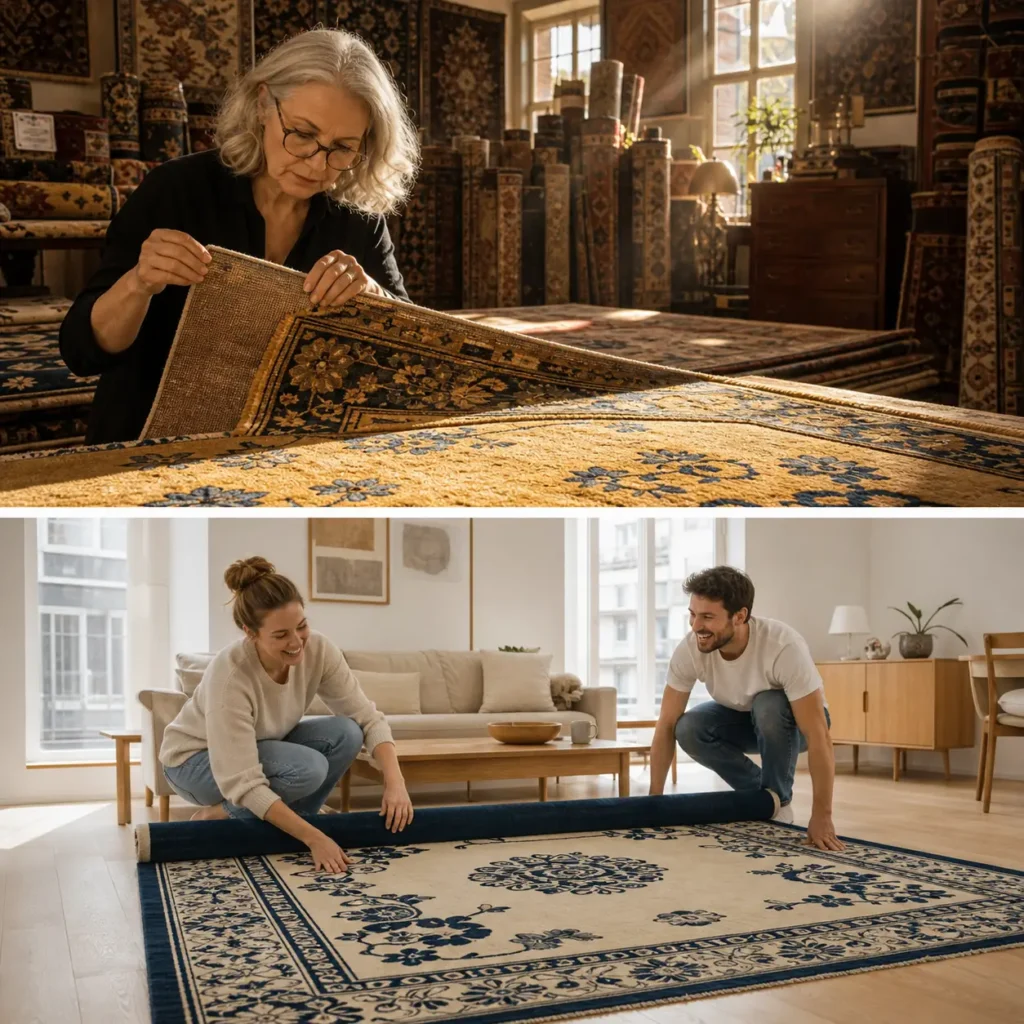
- Knots per inch: period Chinese rugs are fairly coarse by Persian standards. Sources put most of them somewhere around 50 to 90 knots per square inch, often described as “90 line” in the Chinese system. A very fine weave is not proof of age, since many later Chinese rugs are finer.
- The back of the rug: flip a corner. On a hand-knotted rug you can see the design clearly and count individual knots. A canvas, mesh or latex backing means a tufted or machine-made rug.
- Wear: look for honest, even wear on a rug that is about a hundred years old, sometimes with tiny white foundation knots showing in worn spots. Wear that looks sanded on or appears only in perfect patches can be artificial aging.
- Fringe: on a hand-knotted rug the fringe is the end of the warp threads running through the rug. A fringe sewn or glued onto the edge points to machine-made construction.
- Dyes: because Nichols and others used chrome dyes, original colors can still look bright. Very saturated color alone does not mean a rug is new, but color that looks identical everywhere, with no softening where it has been walked on, deserves a closer look.
- Weight and feel: a Nichols rug is heavy and stiff thanks to its dense, closed-back weave. A Fette-Li rug feels softer and folds more easily.
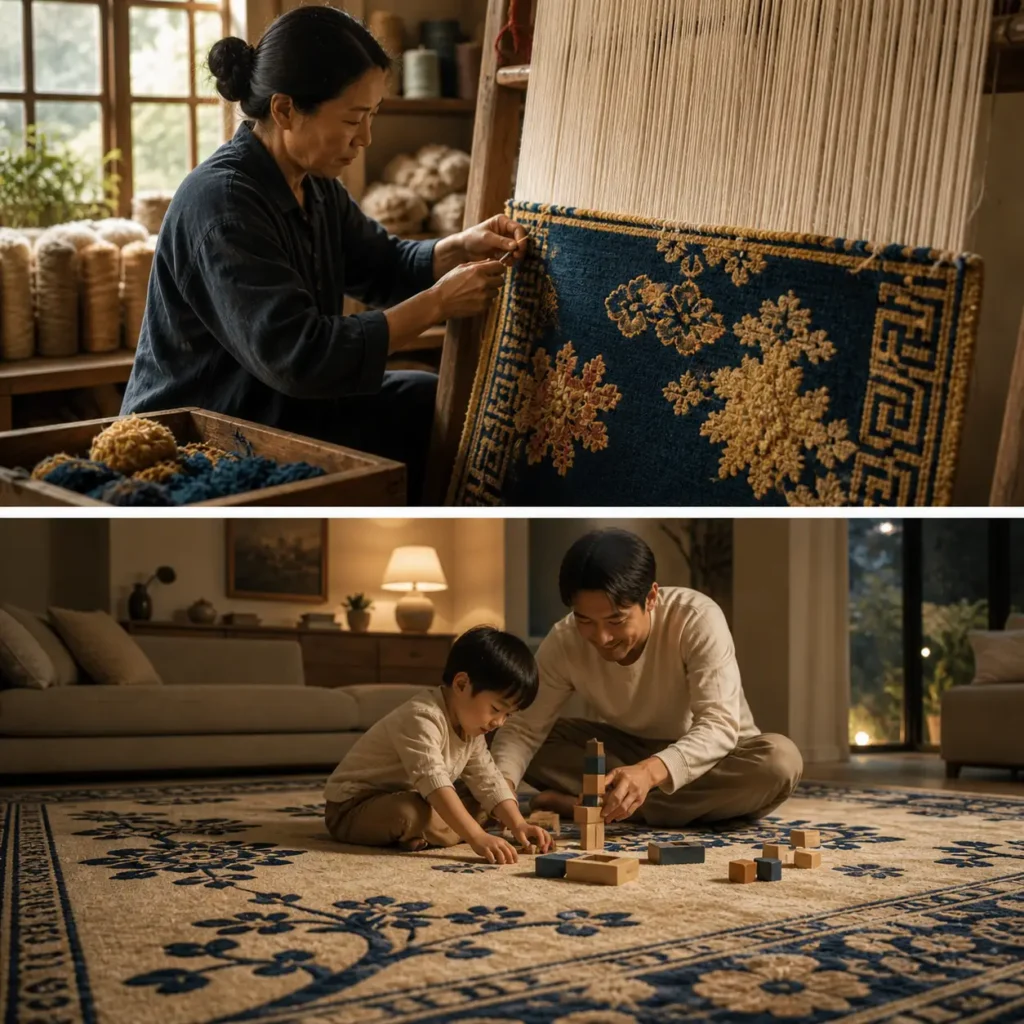
How to Spot a Real Nichols Rug
Check the back of the fringe for a stamp, often in blue ink, reading “Made in China by Nichols.” Look for an original fabric label on the underside, or stitch marks where one used to be. Many genuine rugs have lost both, so dealers often call an unmarked piece “Nichols style.” If the price is high, ask for an independent appraisal before you pay.
Antique, Vintage and Reproduction Chinese Art Deco Rug Prices
Prices swing a lot, so it helps to know which category you are looking at. These are typical ranges drawn from past auction results and dealer asking prices, not current quotes, and they shift with size, condition and the market.
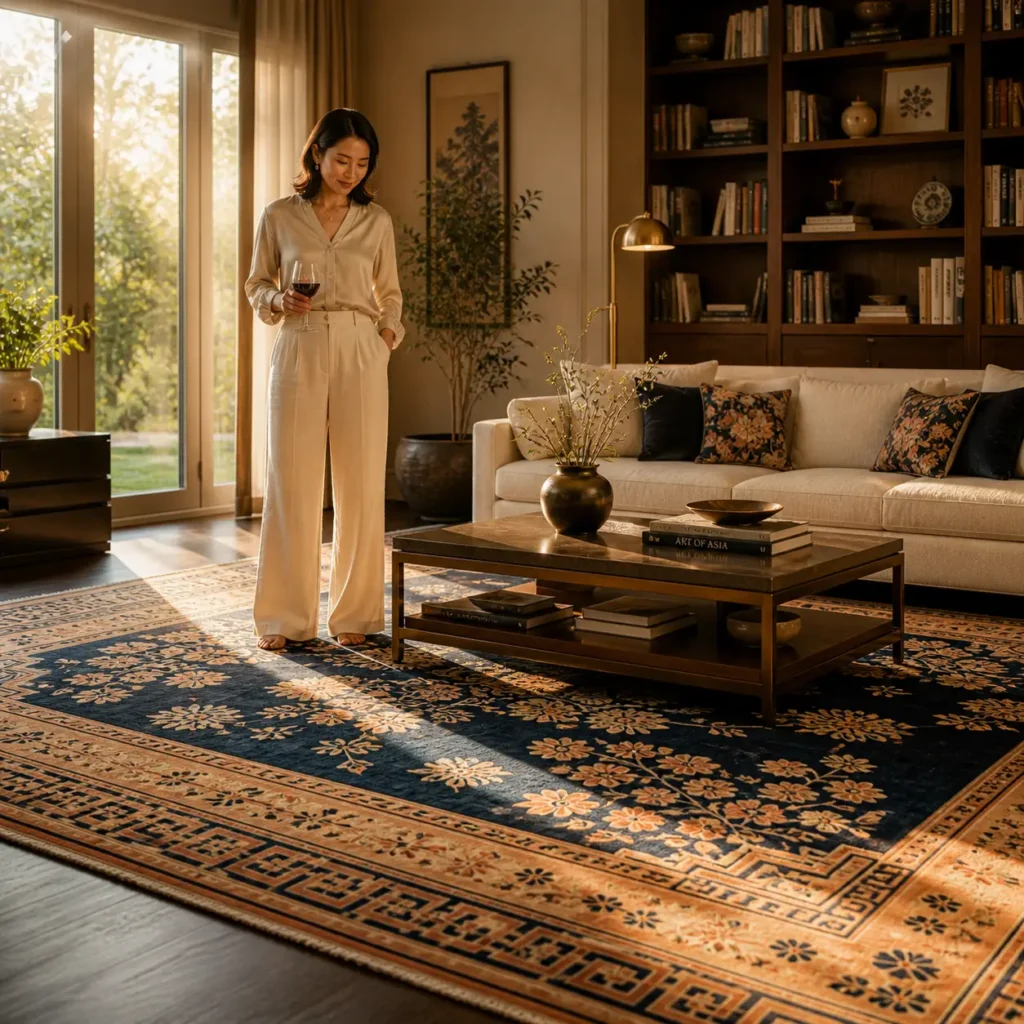
- Antique (1920s to 1930s): room-size Nichols and other Chinese Deco carpets typically sell at auction for roughly $400 to $2,600, with worn or repaired pieces at the bottom. Specialist dealers usually ask about $2,000 to $10,000 or more for room sizes, with rare colors and labeled pieces at the top.
- Vintage (about 1960s to 1980s): later hand-knotted Chinese rugs in the Deco style typically list at dealers for roughly $1,500 to $3,500 for an 8×10.
- New hand-knotted reproductions: made-to-order pieces typically run roughly $1,700 to $3,000 or more, with a 3×5 at the low end and an 8×10 at the top.
- Machine-made look-alikes: printed or power-loomed rugs usually cost about $40 to $150, depending on size.
The biggest price drivers are age and provenance (an original label helps), condition, size, unusual colors such as lavender or coral, and shape, since ovals and rounds are scarcer. Heavy repairs, moth damage and faded spots pull the price down quickly.
| Type | Era | Typical Price | Best For |
|---|---|---|---|
| Antique | 1920s to 1930s | $2,000 to $10,000+ at dealers | Collectors who want history and provenance |
| Vintage | About 1960s to 1980s | $1,500 to $3,500 for an 8×10 | Real wool and hand-knotting at a lower price |
| Nichols-style reproduction (hand-knotted) | New, made to order | $1,700 to $3,000+ | Custom size or color with real craftsmanship |
| Modern machine-made | New | $40 to $150 | Budget rooms, kids, pets and easy washing |
Are Chinese Art Deco Rugs Worth It?
If you love the look and want a piece with history, an antique or vintage rug in good condition can be a lovely long-term buy. Just treat it as something to enjoy rather than a guaranteed investment, since auction prices for these rugs have moved up and down over the years. If you mainly want the style for a room, a reproduction gives you most of the effect for a fraction of the cost.
Where to Buy Chinese Art Deco Rugs (and What Good Reproductions Cost)
For antique and vintage rugs, start with specialist rug dealers and established auction houses, plus online auction platforms that gather sales from smaller houses. Ask for clear photos of the back and fringe, a written condition report and a return policy before you commit.
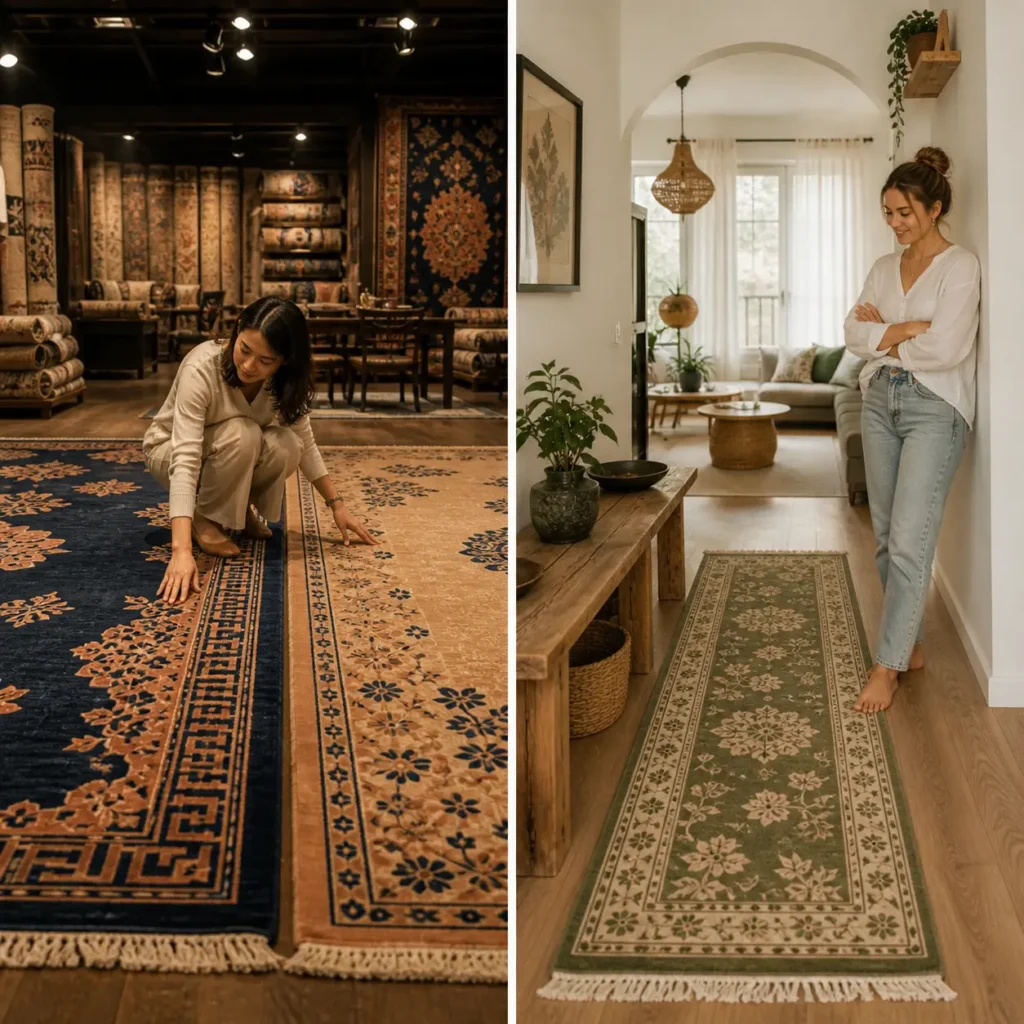
Budget-Friendly Reproduction Picks
If your budget is closer to a weekend project than an auction paddle, these machine-made rugs capture the open-field, floral look. They are reproductions, not antiques, and they are printed and washable, which makes them handy for busy rooms. Our guide to economy home decor has more ways to get a high-end look for less.
For a living room or bedroom, the jinchan Chinoiserie floral area rug in beige and blue has a soft ivory field, scattered floral branches and a slim border, and it comes in sizes up to 8×10. It is thin, so add a rug pad underneath.
In a hallway, the matching jinchan Chinoiserie floral runner brings the same look to a long, narrow space and goes in the washing machine on a gentle cycle.
If you lean more Art Deco than Chinese, the JONATHAN Y Ariana Art Deco arches runner uses a two-tone, high-low pile of stacked arches that pairs nicely with a vintage Chinese rug in the next room.
Types, Colors and Sizes of Vintage Chinese Art Deco Rugs
Vintage Chinese Art Deco rugs come in more variety than people expect. Deep navy, sometimes called “Nichols blue,” is one of the best-known colors, along with jade green, rose, plum and quieter camel and champagne tones.
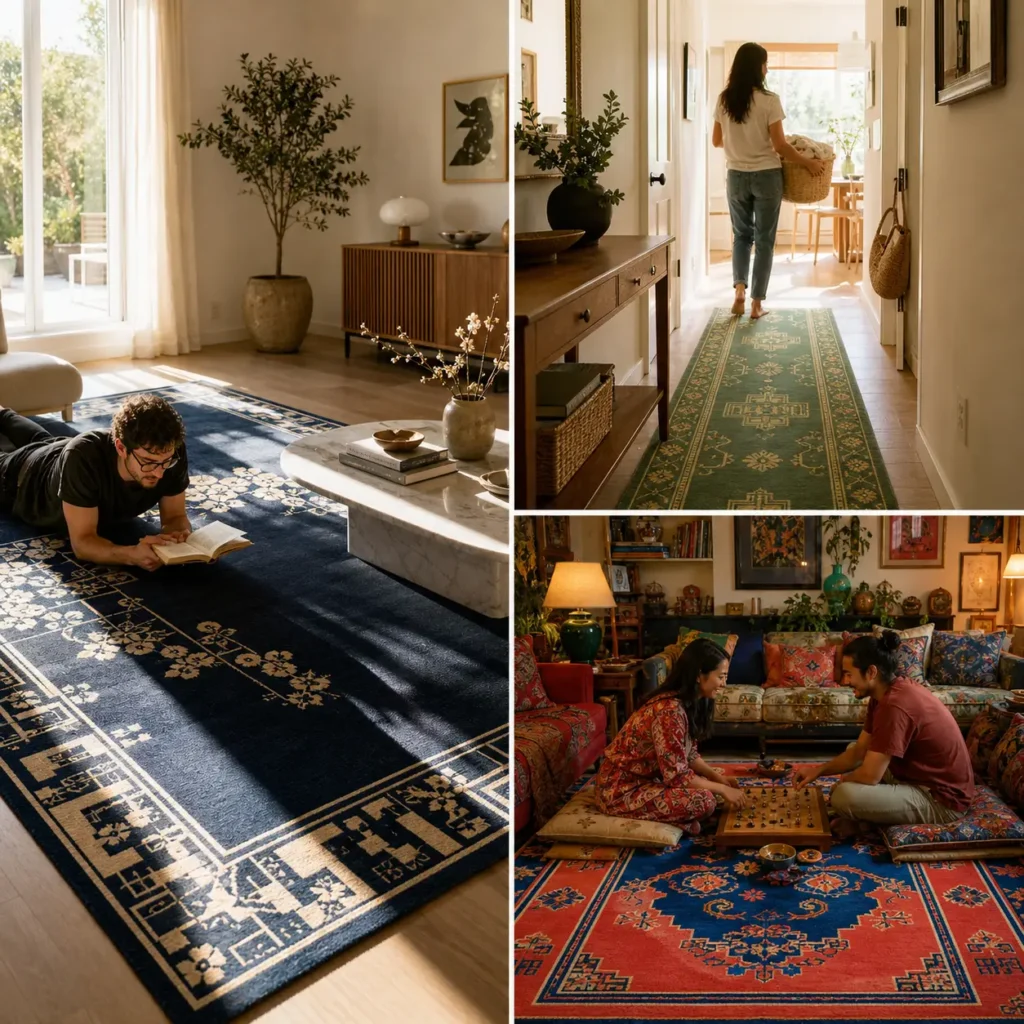
Room sizes around 9×12 and 8×10 are the most common, with small scatter rugs, runners, ovals and rounds turning up less often. For a living room, an 8×10 or 9×12 usually lets at least the front legs of the sofa and chairs sit on the rug, with a border of bare floor around the edges. Our rug sizes chart walks through the measurements room by room.
How to Style a Chinese Art Deco Rug in Modern Interiors
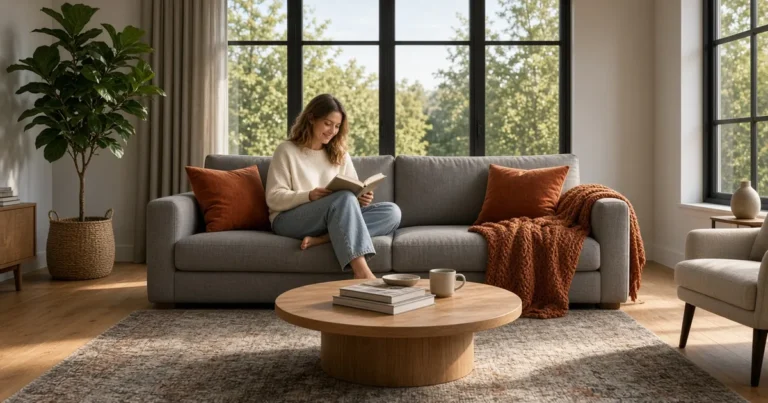
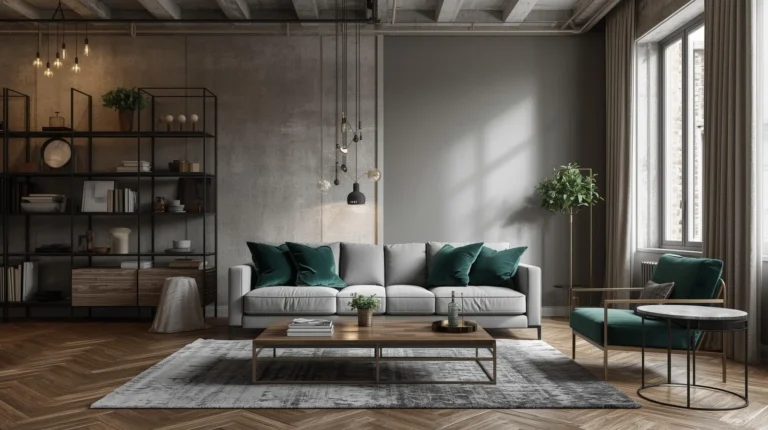
The easiest rule is to let the rug lead and keep everything around it a little quieter. A plain sofa in cream, grey or soft white gives a colorful rug room to shine, and our grey sofa living room ideas show how well that pairing works.
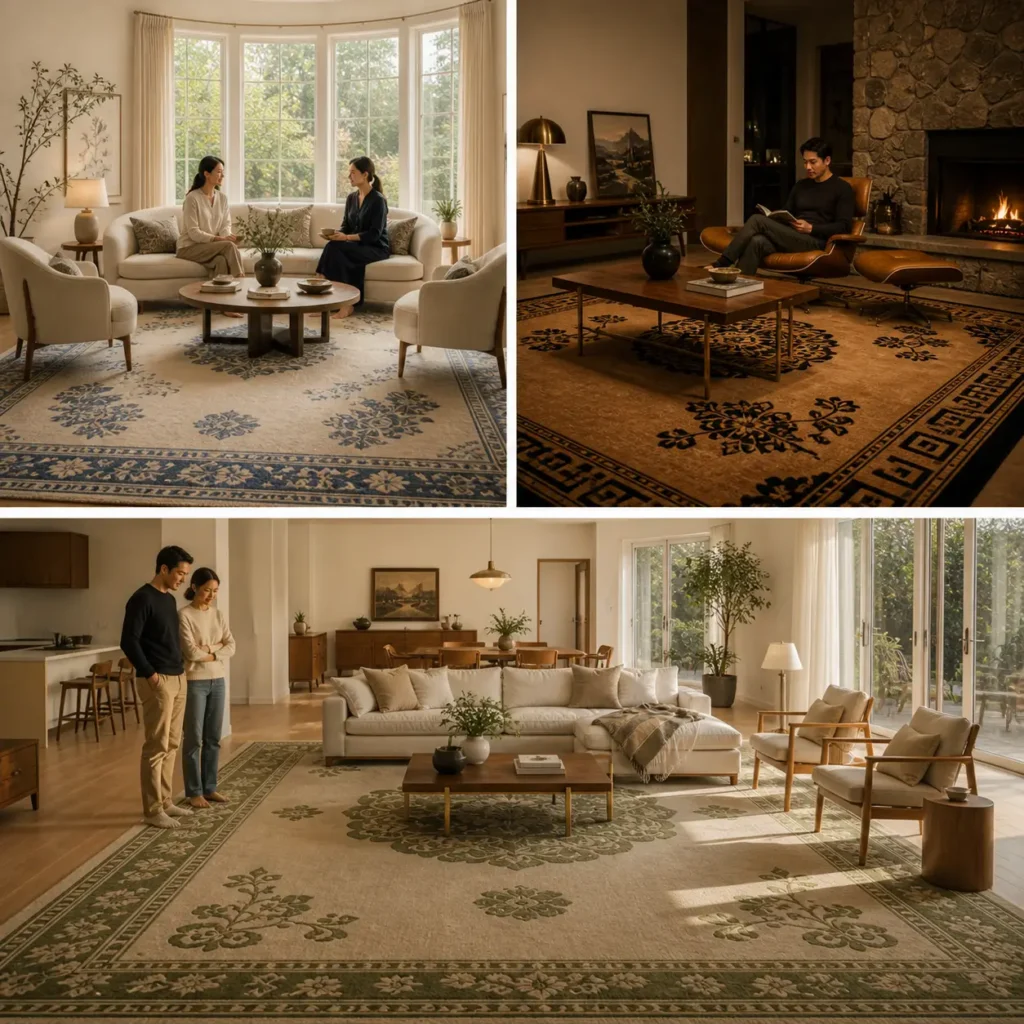
- Pull one or two colors from the rug for pillows, a throw or artwork rather than matching every shade.
- Add warm materials like walnut or oak, brass and linen, which echo the rug’s era without feeling like a museum.
- Mix eras with intent: mid-century chairs, a minimalist coffee table and a 1920s rug look collected, not random.
- Go traditional if you like: these rugs also suit richer rooms, and our Victorian living room guide shows how to layer pattern and wood.
Styling Mistakes to Avoid
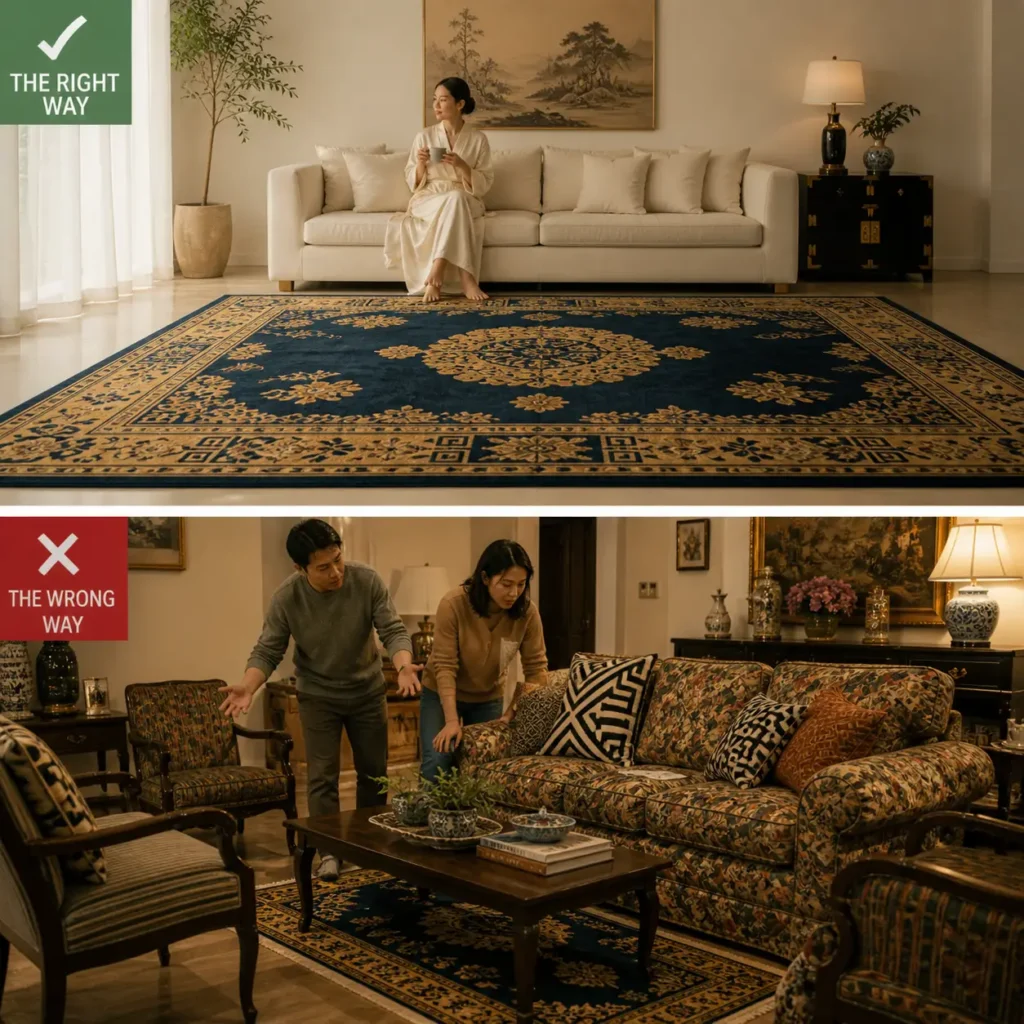
- Competing patterns: a busy sofa fabric next to a busy rug. Fix: choose solid upholstery and keep pattern to small accents.
- A rug that is too small: it floats in the room and looks like an afterthought. Fix: size up so furniture legs can rest on it.
- Covering the best part: placing a heavy coffee table right on top of the main motif. Fix: shift the table or turn the rug so the design shows.
- Too many colors: Fix: repeat the rug’s main color once or twice and let the rest stay neutral.
How to Clean and Care for a Chinese Art Deco Rug
Good care keeps an old rug looking good for decades, and it is mostly about being gentle.
- Vacuum with suction only: turn off the beater bar or use a brushless head, and keep it away from the fringe.
- Blot spills right away with a white cloth. Never rub, and test any cleaner on a hidden corner first because some dyes can bleed when wet.
- Leave deep cleaning to a specialist for antique and vintage rugs. Avoid soaking, steam cleaning and harsh detergents at home.
- Rotate the rug once or twice a year so wear and sun exposure even out, and keep it out of strong direct sunlight.
- Use a good pad, ideally felt with natural rubber, to stop slipping and cushion the knots.
- Store it rolled, not folded, pile side in, wrapped in breathable fabric rather than plastic, and check it for moths.
Washable reproductions are much simpler: follow the maker’s label, which for most printed rugs means a cold, gentle machine wash and air drying. For patios and porches, a wool rug is the wrong choice, so look at our picks for the best outdoor rugs instead.
Is a Chinese Art Deco Rug Right for Your Home?
If you love color, history and a bit of drama underfoot, a Chinese Art Deco rug is a beautiful choice. Buy an antique or vintage piece when the story and craftsmanship matter to you, check the back, fringe and wear before you pay, and look after it gently. If you simply want the look, a well-chosen reproduction can give your room that same calm, open, 1920s feel.
Chinese Art Deco Rug FAQ
How much is a Chinese Art Deco rug worth?
It depends on age, size, condition and provenance. Room-size antiques typically sell at auction for roughly $400 to $2,600, while dealers often ask $2,000 to $10,000 or more. Vintage 8×10 pieces usually list for about $1,500 to $3,500, and machine-made reproductions cost far less.
How can you tell if a Chinese Art Deco rug is authentic?
Turn it over. A genuine rug is hand-knotted, with the design visible on the back, a fringe made from the warp threads and no glued or latex backing. Even, natural wear and an original label or fringe stamp are good signs. For a high-value rug, ask for an independent appraisal.
What is a Nichols rug?
A Nichols rug was made by Walter Nichols’s company in Tientsin (Tianjin), China, which he opened in 1924. These rugs are dense, heavy and colorful, and some carry a “Made in China by Nichols” stamp on the fringe. The name is also used loosely for any rug in the same style.
Are reproduction Chinese Art Deco rugs worth it?
Yes, if you want the look rather than an antique. Hand-knotted reproductions offer real craftsmanship at a high price, while machine-made versions cost much less and are easy to clean. Just know that a reproduction will not hold value like a period piece.
How do you clean a Chinese Art Deco rug?
Vacuum with suction only, blot spills with a white cloth and test any cleaner in a hidden spot first. Send antique and vintage rugs to a specialist for deep cleaning. Most washable reproductions can go in the machine on a cold, gentle cycle.
Are Chinese Art Deco rugs handmade?
Original 1920s and 1930s rugs are hand-knotted wool on a cotton foundation. Many modern versions are machine-made or printed, so check the back and the product details before you buy.