Some houses stop you mid-scroll. A red brick facade with perfectly spaced windows, a stone château with a turret, a glass box floating over a hillside. They are all mansions, yet they look nothing alike, because the types of mansions are really defined by architectural style, not just square footage.
Below, I walk through 10 types of mansion styles with pictures, from Georgian and Tudor to modern farmhouse and contemporary glass, plus the L-shaped layout behind so many luxury homes today. For each one, you will also see how to borrow the look for your own home, whether you rent a one-bedroom or own a starter house. Expensive style is mostly about proportion, symmetry, and a few smart materials, and those are surprisingly affordable.
This post contains affiliate links. As an Amazon Associate, I earn from qualifying purchases, at no extra cost to you.
What Makes a House a Mansion?
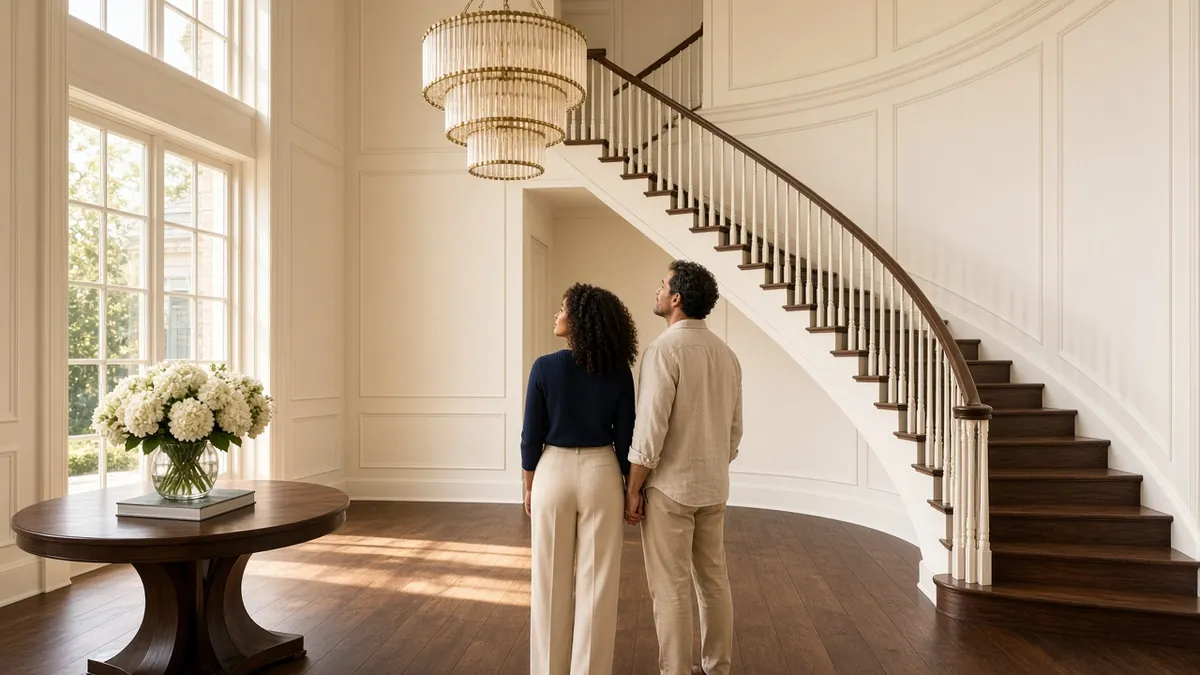
There is no official legal definition of a mansion. In U.S. real estate, the word is commonly used for homes of roughly 5,000 square feet or more, while some agents reserve it for 8,000 square feet and up. Size alone does not tell the whole story, though. Most houses we call mansions also share generous ceiling heights, a formal entry sequence, high-end materials, and land around them.
Luxury homes are a broader category. A 3,000-square-foot house with custom finishes in a sought-after neighborhood can be a luxury home without being a mansion. When people look up types of mansion architecture or types of mansion house designs, they usually mean the style: the roofline, facade, windows, and ornament that give a house its identity. For the wider picture beyond grand estates, our guide to 16 architectural styles that give homes their character covers everyday house styles too.
Classic Mansion Styles: Georgian, Neoclassical, and Beaux-Arts
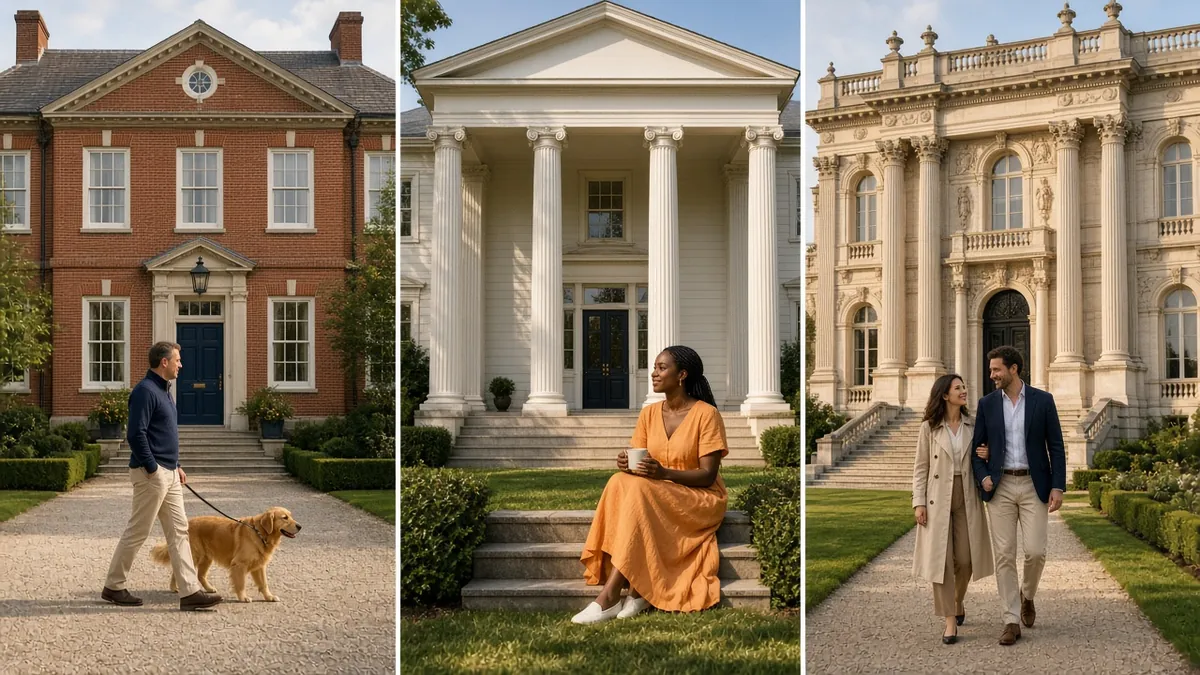
These are the formal, symmetrical styles most people picture first. They borrow from classical Greek and Roman architecture, so balance and proportion do most of the work.
1. Georgian Mansions
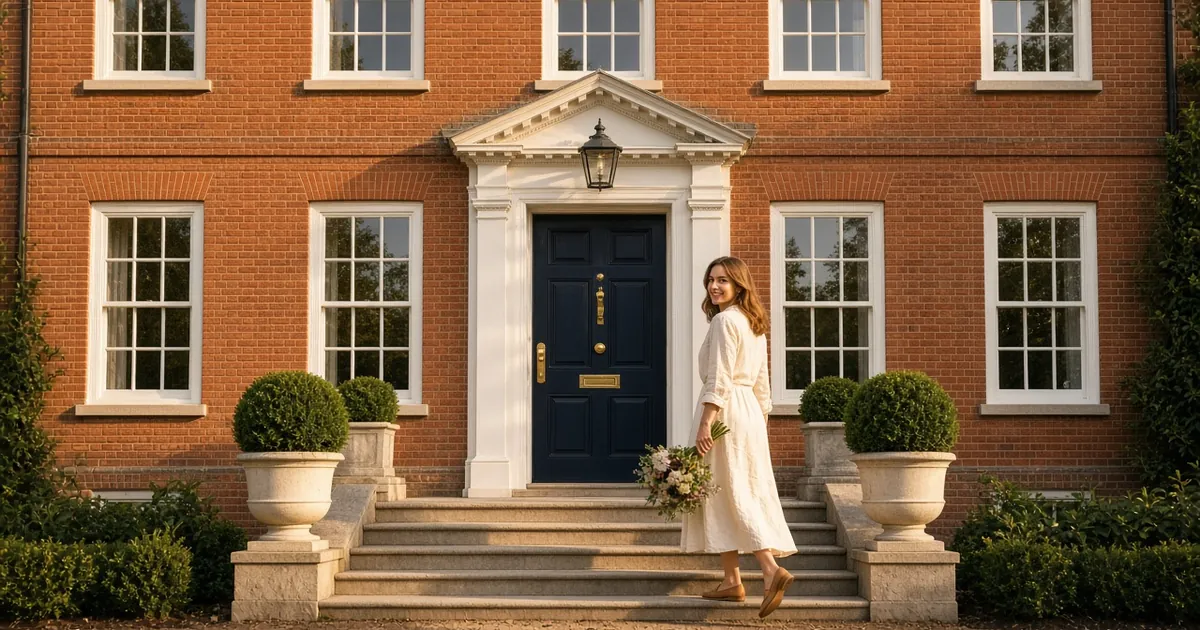
Georgian architecture takes its name from Britain’s four King Georges, who reigned from 1714 to 1830, and it dominated the American colonies for much of the 18th century. Look for a strictly symmetrical facade, often five windows across the upper floor, and a centered paneled front door topped with a decorative crown or pediment. Multi-pane sash windows and brick or stone walls complete the look.
Borrow the look: Georgian style is really about pairs. Flank a sofa, bed, or console with matching lamps and matching art, and the room instantly feels composed. If you have a fireplace, center everything on it; these modern fireplace mantel ideas show how to keep that symmetry feeling fresh rather than stuffy.
2. Neoclassical and Greek Revival Mansions
The giveaway is a full-height portico: tall columns holding up a triangular pediment across the front of the house. Greek Revival swept the United States between about 1825 and 1860, and later Neoclassical homes (roughly 1895 to the 1950s) revived the grand columned entry at an even bigger scale. White or pale exteriors, wide cornice bands, and tall first-floor windows finish the picture.
Borrow the look: Think vertical. Hang curtain rods 4 to 6 inches below the ceiling and let the panels just kiss the floor to fake taller windows. A fluted pedestal or a plaster-look column lamp echoes those columns without feeling themed.
3. Beaux-Arts (Gilded Age) Mansions
Beaux-Arts is the most theatrical of the classical styles, popular in America from about 1885 to 1930 among the era’s wealthiest families. Expect paired columns, balustrades along the roofline, heavy stone, and carved garlands or shields. Marble House in Newport, Rhode Island, designed by Richard Morris Hunt for William K. Vanderbilt and completed in 1892, is a textbook example.
Borrow the look: Choose one gilded moment instead of ten. A brass-framed mirror or a single marble-look side table reads as Gilded Age luxury, while gold on every surface tips into costume.
European-Inspired Mansion Styles: Tudor, French Château, and Mediterranean
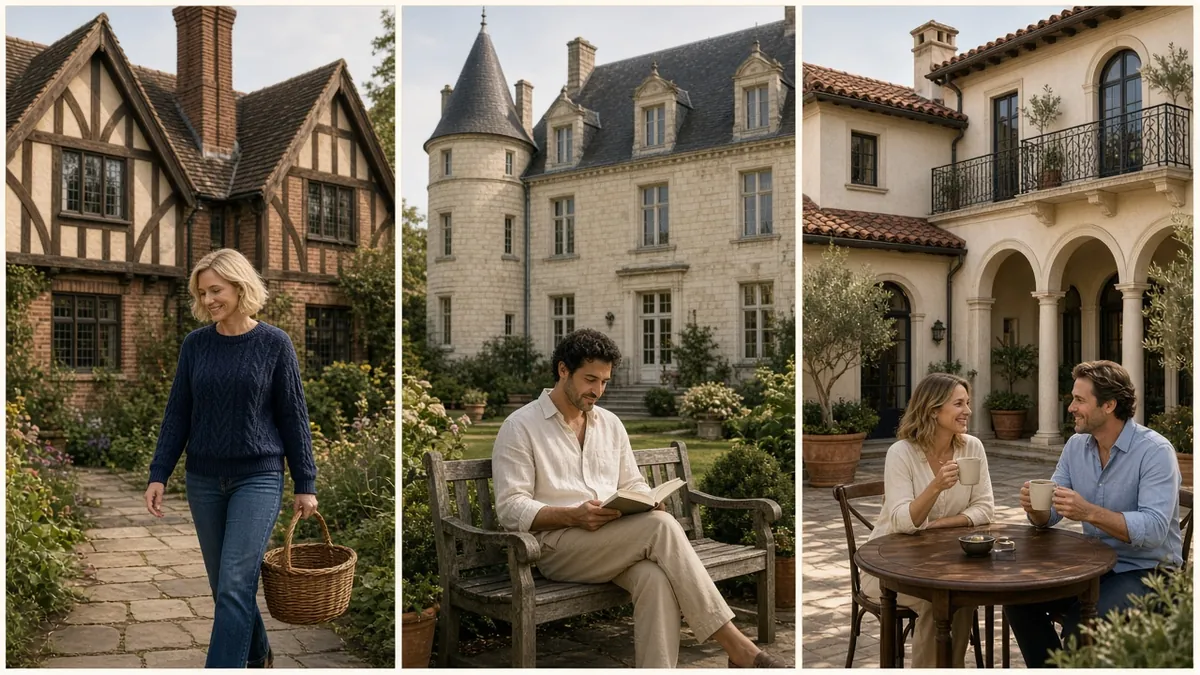
These revival styles brought Old World romance to American suburbs and estates in the late 1800s and early 1900s. They feel warmer and more textured than the classical group.
4. Tudor Revival Mansions
Tudor Revival homes, built in the U.S. mostly from about 1890 to 1940, draw on English manor houses of the 1500s and early 1600s. The signatures are steeply pitched front-facing gables, decorative half-timbering over stucco or brick, tall narrow windows with small leaded panes, and massive chimneys. In the UK, you will find the originals alongside plenty of Victorian and Edwardian “mock Tudor” homes.
Borrow the look: Lean into warm wood, deep colors, and layered textiles. A dark walnut tray, a few leather-bound books, and a vintage-style rug in navy and rust give even a plain rental that cozy manor-house mood.
5. French Château and Provincial Mansions
The American Châteauesque style (about 1880 to 1910) copies the castles of France’s Loire Valley: steep hipped roofs, turrets, tall dormers, and pale stone. The most famous example is the Biltmore Estate in Asheville, North Carolina, completed in 1895 for George Washington Vanderbilt II and widely described as the largest privately owned house in the United States. French Provincial homes are the calmer cousin, with symmetrical stucco or brick facades, hipped roofs, and tall arched windows.
Borrow the look: French style loves curves and softness. Try a curved-back dining chair, washable linen slipcovers, and an oversized arched mirror leaning against the wall.
6. Mediterranean and Spanish Revival Mansions
Mediterranean and Spanish Colonial Revival homes took off after San Diego’s 1915 Panama-California Exposition and flourished in California and Florida through the 1920s and 1930s. In Palm Beach, architect Addison Mizner designed many of the era’s best-known Mediterranean-style estates. Look for smooth stucco walls, red clay barrel-tile roofs, arched doorways, wrought-iron balconies, and courtyards built for outdoor living.
Borrow the look: Terracotta pots, a wrought-iron accent, and a realistic faux olive tree in a bright corner bring that sun-warmed feel indoors. A good faux tree also sidesteps soil-digging pets and toddlers. Our indoor plant styling ideas explain how to scale greenery so it looks intentional.
American Originals: Victorian and Shingle Style Mansions
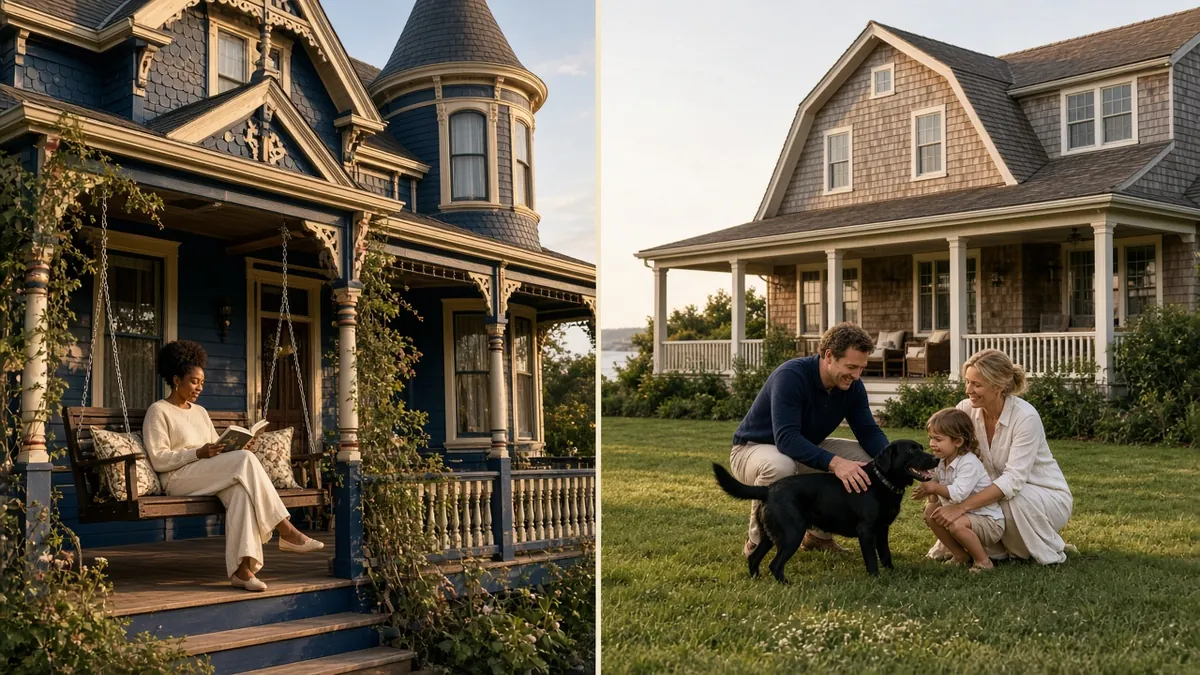
Both of these grew up in the late 1800s and feel distinctly American. Deep porches and asymmetrical shapes give them a more relaxed attitude than the classical estates.
7. Victorian (Queen Anne) Mansions
Victorian refers to an era, Queen Victoria’s reign from 1837 to 1901, rather than a single style. The mansion most people picture is Queen Anne, popular in the U.S. from about 1880 to 1910, with asymmetrical shapes, round or polygonal towers, wraparound porches, bay windows, and patterned shingles. The Carson Mansion in Eureka, California, built in the 1880s for lumber baron William Carson, is one of the most photographed examples.
Borrow the look: Pick one ornate hero, like a carved mirror or a velvet chair, and keep everything around it calm. Victorian living rooms look expensive when pattern has room to breathe.
8. Shingle Style Mansions
Shingle Style emerged in New England seaside resorts in the 1880s, when firms such as McKim, Mead & White designed summer “cottages” that were really mansions. The whole exterior is wrapped in continuous wood shingles, with sweeping rooflines, wide porches, and irregular gables. Many of today’s classic Hamptons estates revive this look almost exactly.
Borrow the look: Navy and white, woven textures, and slipcovered seating. It is the most family-friendly mansion aesthetic because it was designed for relaxed summers, sandy feet, and wet dogs.
Modern Luxury Homes: Farmhouse Estates and Contemporary Glass Mansions
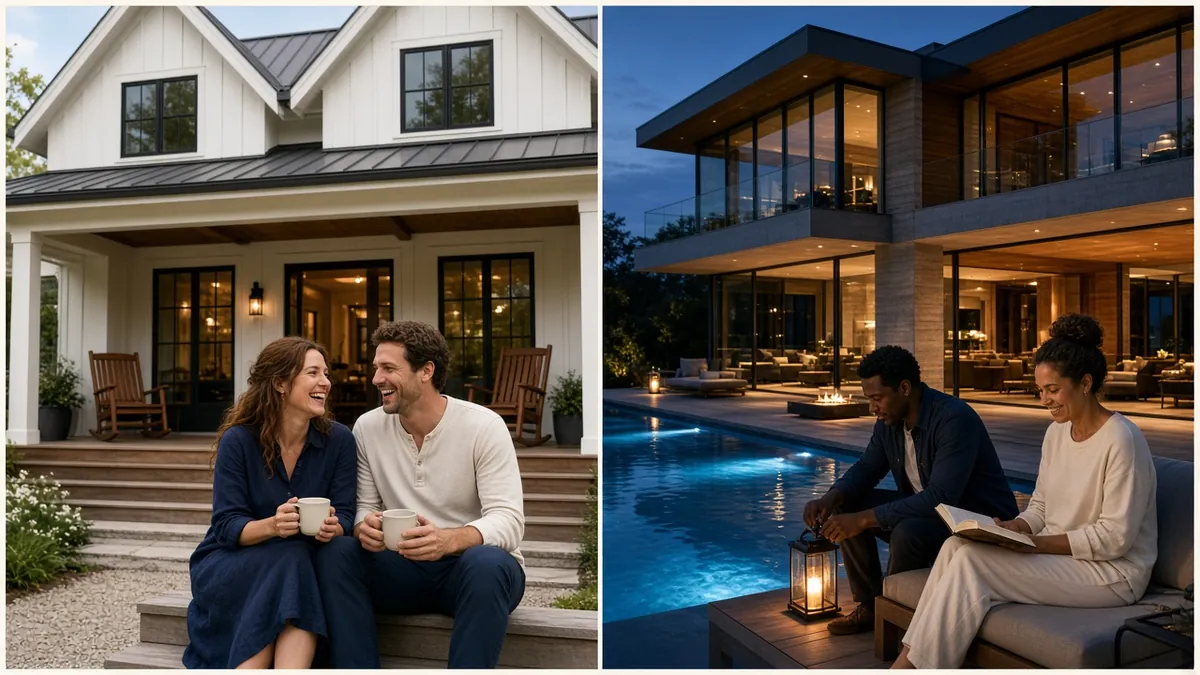
Today’s types of luxury houses lean on clean lines, big glass, and open plans. These two styles dominate new high-end construction in the U.S., Canada, and Australia.
9. Modern Farmhouse Estates
The modern farmhouse took over new luxury construction in the 2010s. At mansion scale, it pairs simple gables and deep porches with board-and-batten siding, black-framed windows, standing-seam metal roof accents, and a white or near-white exterior. Inside, you will usually find vaulted ceilings, exposed beams, and an enormous open kitchen.
Borrow the look: Black metal hardware, a chunky wood dining table, and warm white walls. Keep accessories minimal so the room reads as modern rather than rustic.
10. Contemporary and Modern Mansions
Contemporary mansions trade ornament for drama: flat or low-slope roofs, walls of floor-to-ceiling glass, cantilevered upper floors, and materials like concrete, steel, and warm timber. They are built around indoor-outdoor living, so pools, terraces, and sliding glass walls blur the line between inside and out. You will spot them on Los Angeles hillsides, in Miami, and in modern builds across the UK and Australia.
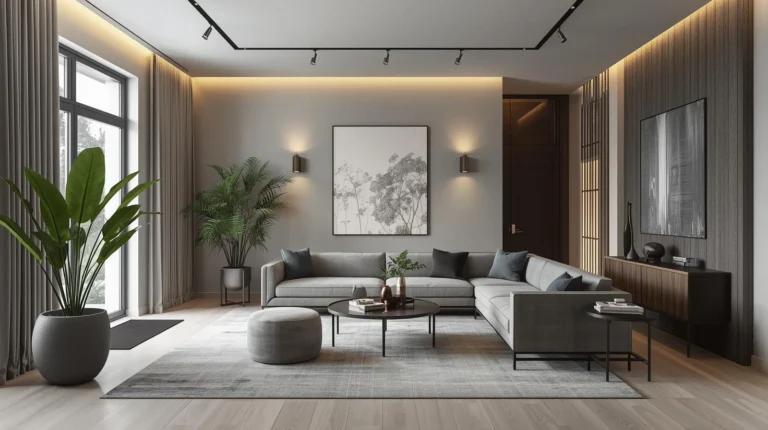
Borrow the look: Negative space is the luxury here. Clear your surfaces, choose one sculptural light, and let a low-profile sofa and a generous rug anchor the room.
L-Shaped Mansions: Why This Layout Works So Well
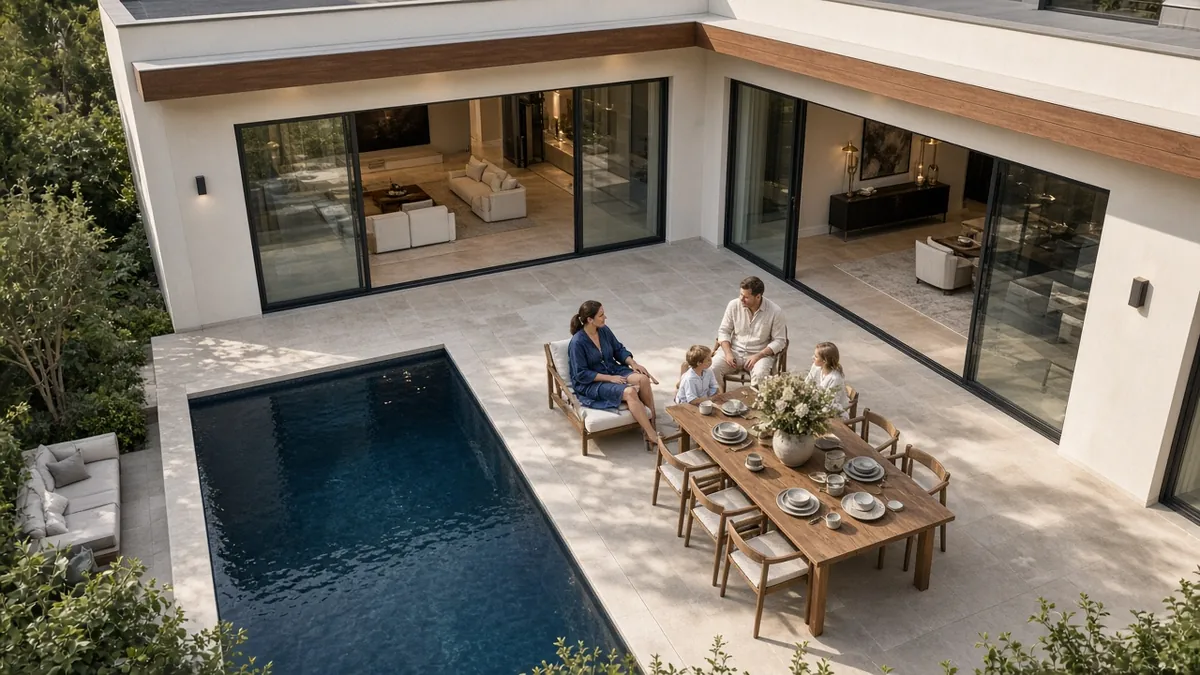
An L-shaped mansion describes the floor plan, not the style. Two wings meet at a right angle, so the same footprint can wear Spanish, farmhouse, ranch, or ultra-modern details. Wing-based planning has deep roots, too: Elizabethan country houses in England famously used E- and H-shaped plans, and the L is the simplest version of that idea.
The appeal is practical. One wing usually holds the social spaces (kitchen, living, and dining) while the other keeps bedrooms quiet and private. The inside corner wraps a pool, courtyard, or garden, which blocks wind and street views and turns outdoor space into another room. Each wing can also have windows on more sides, so daylight and cross-breezes reach deeper into the house.
Borrow the look: You can create the same wrap-around effect in a living room. An L-shaped sectional, or a sofa plus a chair set at 90 degrees, forms a natural conversation corner that is ideal for hosting. Leave 16 to 18 inches between the seat edge and the coffee table and 30 to 36 inches for walkways so the corner never feels cramped.
How to Get the Mansion Look at Home on a Budget
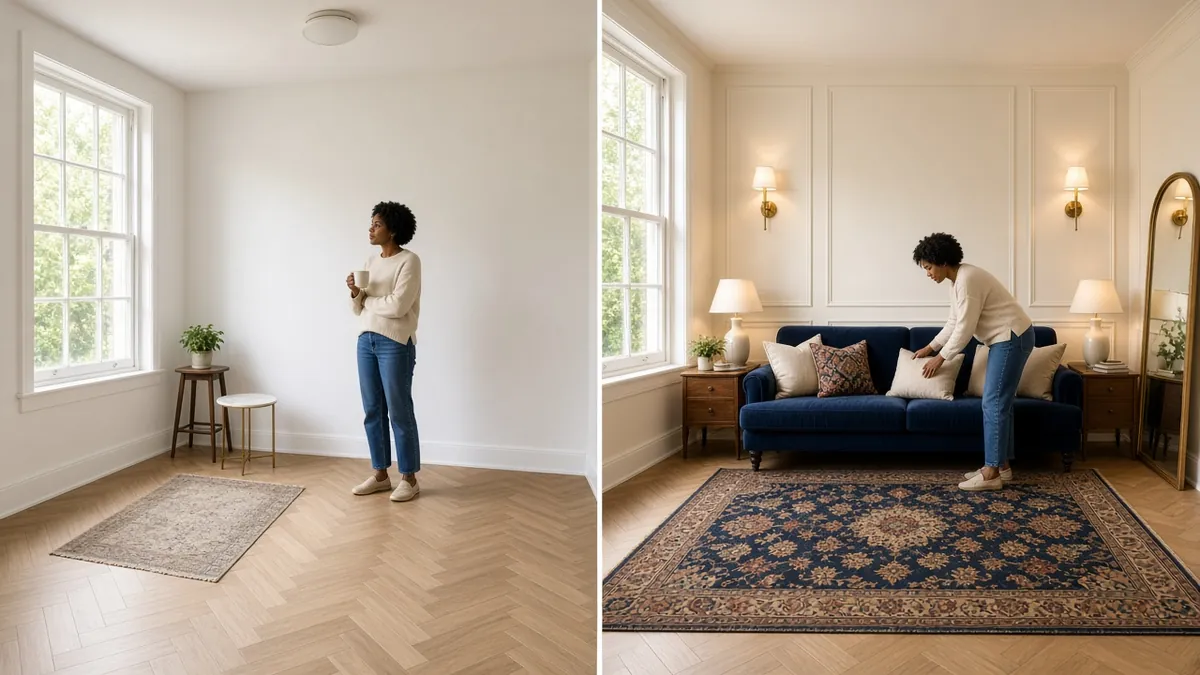
Look closely at any of these types of luxury homes and you will notice the same few ingredients: symmetry, height, layered light, and quality-looking surfaces. None of them requires a mansion budget. Here is where I would save and where I would splurge.
Start With Symmetry and Pairs
Symmetry makes the brain read a room as calm and deliberate, which is exactly why formal mansions feel so composed. A matching pair of ceramic table lamps is the easiest way to get there. For side tables around 24 inches tall, lamps roughly 26 to 30 inches high put the bottom of the shade near eye level when you are seated. Budget pairs typically run about $60 to $150, and a splurge in the $250-plus range buys heavier bases and linen shades.
Add Architectural Detail Without Renovating
Paneled walls are the biggest mansion tell, and peel-and-stick wall molding trim lets you fake picture-frame panels in an afternoon. Keep the gaps between boxes consistent, usually 3 to 4 inches, and match the top and bottom margins so the panels look original. Kits generally cost around $25 to $80 per wall. Renters should test a hidden patch first, since some adhesives can lift paint.
Paint the molding the same color as the wall. This tonal trick shows the detail through shadow instead of contrast, which is how high-end homes keep paneling looking quiet and expensive.
Layer Light Like a Grand Home
Mansions rarely rely on one ceiling light. They layer lamps, sconces, and picture lights so rooms glow in the evening. Plug-in brass wall sconces give you that effect with no electrician; mount them around 60 to 66 inches from the floor, flanking a mirror or bed. A smart budget pair runs roughly $40 to $120, while hardwired designer versions often start near $200 each.
Go Big on Rugs and Mirrors
An undersized rug is the fastest way to make a room look cheap. In most living rooms, an 8×10 lets every front furniture leg rest on it with 12 to 18 inches of floor showing around the edges. With kids or pets, I consistently recommend a washable vintage-style area rug, which gives you the faded heirloom look of a Tudor or Victorian home and goes straight into the washing machine. Budget 8x10s usually land around $60 to $250, while hand-knotted wool starts closer to $600.
Scale is a quiet luxury signal on the walls, too. A tall arched floor mirror, around 65 to 70 inches, bounces light around the room and mimics the arched windows of French and Mediterranean homes. Expect roughly $90 to $200 for a solid budget version and $300 to $600 for a heavier premium frame.
The Designer’s Take
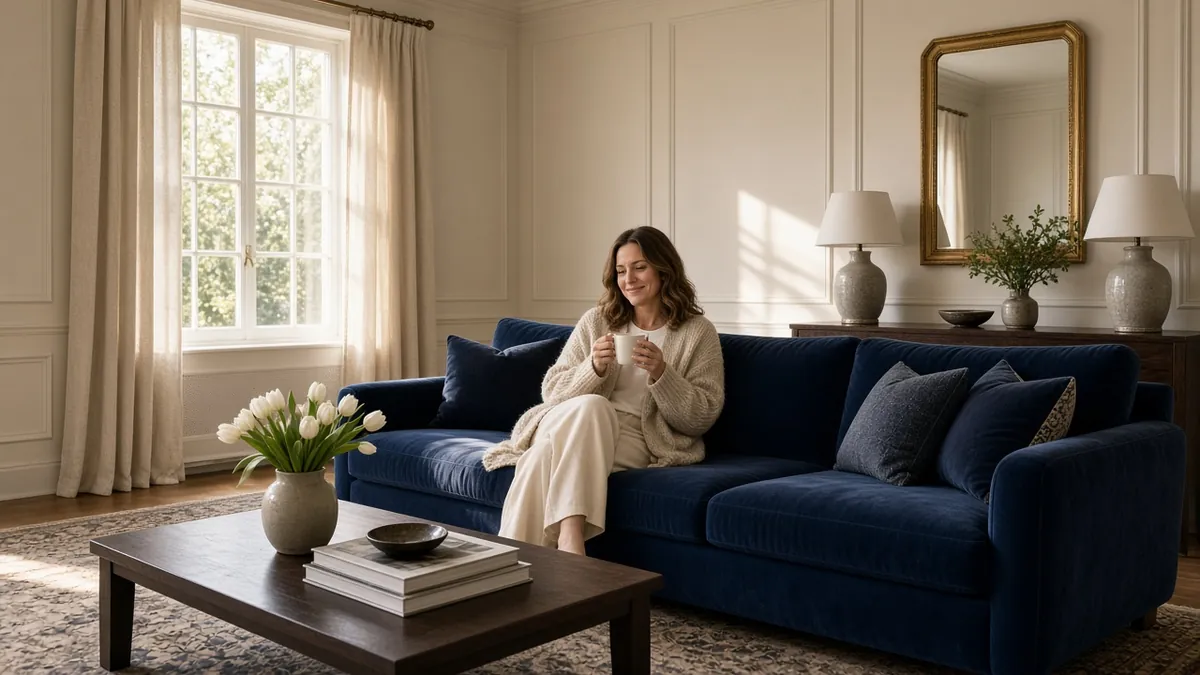
The different types of mansions can look worlds apart, but they share one secret: every detail is intentional. Georgian and Neoclassical homes win with symmetry, Tudor and Victorian with rich texture, French and Mediterranean with curves and warmth, and modern mansions with space and light.
In a small home or rental, pick the one mansion style you keep saving on Pinterest and borrow just two or three of its signatures. A pair of lamps, tonal wall molding, and a properly sized rug will do more than a room full of gilded accessories. Finish the sofa by learning to style throw pillows like a designer, and browse these economy home decor ideas for even more ways to stretch your budget.
Types of Mansions FAQ
What are the main types of mansions?
The main types of mansions are Georgian, Neoclassical or Greek Revival, Beaux-Arts, Tudor Revival, French Château, Mediterranean, Victorian, Shingle Style, modern farmhouse, and contemporary. Each is defined by its roofline, facade, and materials rather than size alone.
How many square feet is considered a mansion?
There is no official cutoff. In the U.S., homes of roughly 5,000 square feet or more are commonly called mansions, and some real estate professionals use 8,000 square feet as the threshold.
What is the difference between a mansion and a luxury home?
A mansion is defined mainly by its size and grand scale. A luxury home is defined by quality, location, and finishes, so a smaller house can be a luxury home without being a mansion.
What is an L-shaped mansion?
An L-shaped mansion has two wings joined at a right angle, often wrapping a pool or courtyard. It is a floor plan rather than a style, so it can be built as anything from Spanish Revival to contemporary.
What is the largest mansion in the United States?
The Biltmore Estate in Asheville, North Carolina, is widely cited as the largest privately owned house in the U.S., with about 250 rooms and roughly four acres of floor space. It was completed in 1895 in the Châteauesque style.